Crash Course History of Science
Season 1
We've been asking big questions for a really long time and we've all wanted to explore how we've sought to answer those questions through the centuries. Questions like, "What is stuff?" and "Where are we?" have inspired people all over the world to investigate. So lets dive in and see how we, as a people, have tried to figure this stuff out in Crash Course History of Science.
Where to Watch Crash Course History of Science • Season 1
46 Episodes
- Intro to History of Science
 E1
E1Intro to History of ScienceFor as long as Hank has hosted Crash Course, he's wanted to host a series about the history of science. We've been asking big questions for a really long time and we've all wanted to explore how we've sought to answer those questions through the centuries. Questions like, "What is stuff?" and "Where are we?" have inspired people all over the world to investigate. So lets dive in and see how we, as a people, have tried to figure this stuff out. - The Presocratics
 E2
E2The PresocraticsLong ago, some philosophers worked very hard to separate myths from what they actually knew about nature. Thales theorized that everything in the world is made of water. Pythagoras was a mathematical-mystical vegetarian. And Democritus, we all know and love as the Atom Guy… Meet the Presocratics! - Plato and Aristotle
 E3
E3Plato and AristotleSo, who was this Presocrates guy? Just kidding. Long ago, some philosophers worked very hard to separate myths from what they actually knew about nature. Thales theorized that everything in the world is made of water. Pythagoras was a mathematical-mystical vegetarian. And Democritus, we all know and love as the Atom Guy - Meet the Presocratics. - Roman Engineering
 E6
E6Roman EngineeringThe Romans developed a lot of infrastructure like roads and aqueducts to both help their cities flourish and to... you know... be better at war. But the interesting thing about Roman Engineering is how it was almost all focused on Techne and not Episteme. In this episode of Crash Course History of Science, Hank takes us down the road of road building, domes, and some really cool cement. - The Medieval Islamicate World
 E7
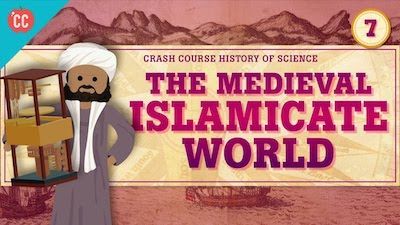
E7The Medieval Islamicate WorldThe religion of Islam significantly influenced knowledge-making in the greater Mediterranean and western Asian world. Islamicate scholars—meaning people influenced by Islamic civilization, regardless of their religious views—gave us terms such as “algebra,” “azimuth,” “algorithm,” “alcohol,” “alkali,” and “alembic.” We’ll dive into Islamic medicine and philosophers such as the great Persian polymath Ibn Sina in future episodes. For now, let’s explore the beginnings of Islamicate natural philosophy. - Medieval China
 E8
E8Medieval ChinaLike Egypt, Sumer, and Mesoamerica, ancient China represents a hydraulic civilization—one that maintained its population by diverting rivers to aid in irrigation—and one that developed writing thousands of years ago. Today, we’re going to focus on the time of the Northern and Southern Song Dynasties, a time of great technical innovation. But, before we get to the Song, let’s take a tour through the ages and explore key elements of Chinese scientific culture. - Ancient & Medieval Medicine
 E9
E9Ancient & Medieval MedicineThe history of medicine is about two of our big questions: one, what is life? What makes it so special, so fragile, so… goopy!? Two, how do we know what we know? Why should I take my doctor’s advice? Why are deep-fried Oreos bad for me? It may be tempting to look at medicine as a science that has simply progressed over time—that medicine used to be bad, and its history is a story of how it got better. - Alchemy
 E10
E10Alchemyn fantasy stories, charlatans in fancy robes promise to turn lead into gold. But real alchemists weren’t just mystical misers. They were skilled experimentalists, backed by theories of matter. And they played a huge role in the development of knowledge about one of our fundamental questions: “what is stuff?” - Cathedrals and Universities
 E11
E11Cathedrals and UniversitiesUntil roughly 1100, there were relatively few places of knowledge-making. Monasteries and abbeys had special rooms called scriptoria where monks copied manuscripts by hand. But the biggest places where knowledge was made were the Gothic cathedrals. Then Universities came along, too. This is the story of those two institutions! - The Scientific Revolution
 E12
E12The Scientific RevolutionSo, what exactly is a scientific revolution? And are they more than just moments in time Historians use to mark the beginning and ending of things through time? In this episode we'll look into some ideas and people named Nick and how they fit into science and the search to understand ourselves and our place in the universe. - The New Astronomy
 E13
E13The New AstronomyThis week on Crash Course: History of the Scientific Revolution—astronomical anomalies accrued. Meanwhile, in Denmark—an eccentric rich dude constructed not one but two science castles! And his humble German assistant synthesized a lot of new, old, and bold astronomical ideas into a single sun-centered, eccentricity-positive system… - The New Anatomy
 E15
E15The New AnatomyThere’s a question to consider that’s pretty daunting: what is life? And to try to answer that question, three tools stand out as being especially useful: A book, some experiments, and the microscope! In this episode, Hank talks to us about all kinds of gross things! It's fun! - The Columbian Exchange
 E16
E16The Columbian ExchangeOver the last four episodes, we’ve examined some of the stories that make up the idea of a “revolution” in knowledge-making in Europe. But we can’t understand this idea fully, without unpacking another one—the so called Age of Exploration. This encompasses a lot of events that happened from 1400 through the 1600s and were driven in part by new ideas about knowledge-making. - Earth Science
 E20
E20Earth ScienceIt's Earth Science time!!!! In this field, natural philosophers were asking questions like, what’s up with fossils? Are they the remains of extinct organisms? Or are they so-called “sports of nature”—rocks that just happen to look like living things but don’t /mean/ anything? And most importantly, how old is… everything? - The Industrial Revolution
 E21
E21The Industrial RevolutionYou probably know some of the signs of industrialization in the nineteenth century: Trains connected cities, symbolizing progress. But they also brought about the destruction of rural lands, divisions between social classes, and rapid urbanization. But there's a whole lot more to talk about in this episode of History of Science! - Darwin and Natural Selection
 E22
E22Darwin and Natural Selection"Survival of the Fittest" sounds like a great WWE show but today we're talking about that phrase as it relates to Charles Darwin and Alfred Wallace. Darwin and Wallace are at the heart of understanding evolution and natural selection. Today, Hank talks about their wonderful (if not seasick inducing) trips around the world. - Eugenics and Fracis Galton
 E23
E23Eugenics and Fracis GaltonAfter Darwin blew the doors off the scientific community, a lot of people did some weird and unscientific stuff with his ideas. Francis Galton and a few others decided natural selection could be used to make the human race "better" and came up with Eugenics. - Thermodynamics
 E26
E26ThermodynamicsIt's time to heat things up! LITERALLY! It's time for Hank to talk about the history of Thermodynamics!!! It's messy and there are a lot of people who came up with some ideas that worked and other that didn't and then some ideas that should have come first actually were figured out second. - Cinema, Radio, and Television
 E29
E29Cinema, Radio, and TelevisionRadio, Cinema, and Television have been staples in news coverage, entertainment, and education for almost 100 years. But... where did they all come from? Who started what and when and why? In this episode, Hank Green talks to us about their birth and a dead elephant. - The Mind/Brain
 E30
E30The Mind/BrainScientists in the nineteenth century discovered a lot about life and matter. But exactly what kind of stuff is the human brain? That one was—and is—tricky. The brain sciences—with experiments and therapies tied to biological theories of the body—emerged in the nineteenth century and came into their own in the early twentieth. - Marie Curie and Spooky Rays
 E31
E31Marie Curie and Spooky RaysIt's time to talk about one of the most awesome scientists that has ever been awesome: Marie Curie. She figured out ways to get an amazing education despite the limitations of her homeland, discovered some really important answers to the question "what is stuff?", and she helped other people (like her husband) complete their own studies and discoveries. - Einstein's Revolution
 E32
E32Einstein's RevolutionThere was physics before Einstein in the same way that there was biology before Darwin. Einstein didn’t just add some new ideas to physics. And he didn’t just add a unifying framework for doing physics, like Newton. Einstein took what people thought was physics, turned it upside down, then turned it inside out. - The Atomic Bomb
 E33
E33The Atomic BombThe story picks up where we left off last time, with Einstein writing the president of his new homeland, the United States, urging him to build a nuclear weapon before Hitler. This is the tale of the most destructive force humans have ever unleashed. The Atomic Bomb. - Genetics and The Modern Synthesis
 E35
E35Genetics and The Modern SynthesisRemember how Darwin and Mendel lived around the same time, but everyone forgot about Mendel until 1900, and even then biologists saw Darwinism and Mendelism as two competing grand theories about how life works? Well, in this episode of Crash Course History of Science, we're going to bring everything together into a new Modern Biology! - The Computer and Turing
 E36
E36The Computer and TuringComputers and computing have changed a lot over the History of Science but ESPECIALLY over the last 100 years. In this episode of Crash Course History of Science, we have a look at that history around World War Two and how that conflict forced changes in computing. - Air Travel and The Space Race
 E37
E37Air Travel and The Space RaceLike the Industrial or the Einsteinian Revolution, the Space Race is a trope, or way of organizing historical events into a story that makes sense. In this story, the two great powers that emerged after World War Two—the United States and Soviet Union—competed to send communications satellites, dogs, and people into outer space. - Bodies and Dollars
 E41
E41Bodies and DollarsAfter World War Two, the applications of basic discoveries in biology took off—and became big business. Today, we’ll look at the rise of Big Pharma and GMO foods. We’ll also discuss how life-science technologies fundamentally changed reproduction: it’s time to invent In Vitro Fertilization and clone a sheep! - The Internet and Computing
 E43
E43The Internet and ComputingWe’ve talked a lot about advances in biotech. But none of those could have happened without advances in computing. It’s time to get back to data and explore the unlikely birth, strange life, and potential futures of the Internet. In this episode of Crash Course History of Science, Hank sits down to talk about how computers have changed, where they're going, and how the internet fits into all of this. - Life and Longevity
 E44
E44Life and LongevityIt's time to have a look at the future of human life and how technology could possibly extend longevity. But, within that tech, are questions of ethics that are not always at the top of mind when the tech is being developed. In this episode, Hank sits down to chat about CRISPR and the science of Human longevity. - Climate Science
 E45
E45Climate ScienceScientists tend to be careful and resistant to big claims. So evidence for the possible end of the living world took a while to be seen as such. In this episode of Crash Course History of Science, Hank talks to us about where Climate Science started and how it works today.